Asia's relationships to the West, a key to brand strategy
In the course of the nineteenth century, as European colonial powers divided Southeast Asia among themselves, Siam remained formally independent. It did so through a carefully negotiated and often anxious process of self-transformation, in which the Siamese elite sought less to resist the West than to demonstrate its own capacity to embody Western values.
The word Siam gave itself for this horizon was siwilai, a transliteration of the English "civilised" that entered the Thai language in the mid-nineteenth century without ever finding a satisfactory local equivalent. This untranslatability is revealing, since Siam had no pre-existing term for what Europe represented: a hierarchical model of human progress with Europe at its summit, which constituted a new form of demand to which existing cultural vocabularies offered no direct response. The Thai historian Thongchai Winichakul describes this period as more ambivalent than a story of imitation: a society that genuinely desired what the West appeared to embody, from modernity to recognition among nations, while appropriating and localising those values in ways that served its own social hierarchies and political survival.
Unlike Vietnam or Burma, Thailand was never formally colonised. It occupies what the anthropologist Michael Herzfeld calls a condition of crypto-colonialism: nominally independent, yet profoundly shaped by colonial pressure, having secured its sovereignty at the cost of economic dependence and cultural concession. Its relationship to the West was consequently more elective than that of its neighbours, and more psychologically intricate.
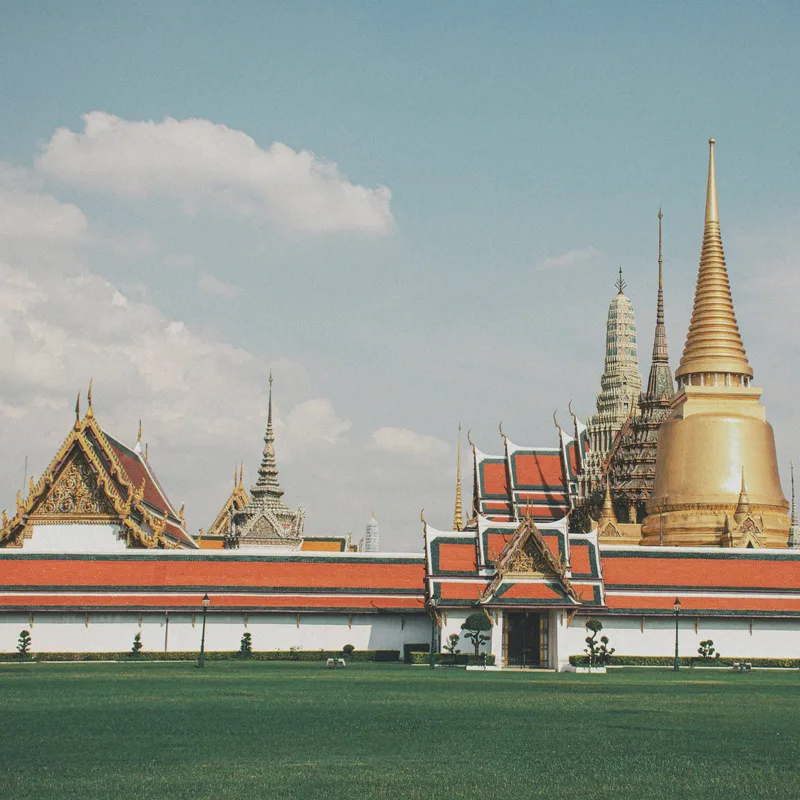
At the turn of the twentieth century, the Siamese elite, wedged between British Burma to the west and French Indochina to the east, navigated colonial pressure through what historians have called buffer diplomacy. On the cultural level, the performances of siwilai were deliberate. At court, men wore the traditional jong kraben with a European-style jacket known as the raja pattaen. Royal women paired Victorian blouses, with their puffed sleeves and lace detailing, with the same jong kraben, in a negotiation between two dress codes that was as political as it was aesthetic. Bangkok itself was transformed, as new avenues and neoclassical buildings reshaped the city while temples and sacred geographies were preserved. The result was a carefully managed hybrid: an attempt to demonstrate civilisational equivalence on terms set by the West, while retaining the social hierarchies and cultural logics that structured Siamese society from within.
This history should matter for a brand seeking to understand the Thai market (or markets). The absence of formal colonisation did not mean an absence of Western influence, but a particular way of engaging with it, selective and strategic, from a position that never fully surrendered its own terms. For European houses, this history suggests leaving Thai clients the role they have long held, that of choosing what to adopt. Presenting the house as a superior model, or turning Thai heritage into exotic decor, runs against this tradition. Services that let clients compose their own pieces, through made-to-order or personalisation, fit it better, as do campaigns in which Thai figures appear as those who select and reinterpret European style.
Thailand is one case among many. Each Asian market carries its own historical grammar in its relationship to the West, shaped by colonisation or by more negotiated forms of resistance. Understanding how these histories have produced distinct models of desirability is a necessary condition for any strategy that hopes to resonate.
Thongchai Winichakul, “The Quest for ‘Siwilai’: A Geographical Discourse of Civilizational Thinking in the Late Nineteenth and Early Twentieth-Century Siam”, The Journal of Asian Studies, vol. 59, no. 3, 2000.
Michael Herzfeld, “The Absent Presence: Discourses of Crypto-Colonialism”, South Atlantic Quarterly, vol. 101, no. 4, 2002.